
A Cisco access port left in dynamic desirable or dynamic auto will form an 802.1Q trunk with anyone on the wire who speaks DTP, and a trunk carries every VLAN. The fast way to prove whether your access ports are safe is to try it: send DTP from Kali with Yersinia and watch the switch. In my home lab, yersinia dtp -attack 1 turned a dynamic desirable port into a full trunk in about 20 seconds, and a dynamic auto port fell to the same frame. Setting switchport mode access with switchport nonegotiate stopped an identical second attack cold.
This post is that measured before and after on a Cisco IOS XE Layer 2 switch. The focus is the Cisco side, how to read show interfaces switchport and show dtp, and the hardening template, not the attack tool. The single trunking test is used only to confirm the port resists. Keep it inside an isolated lab.
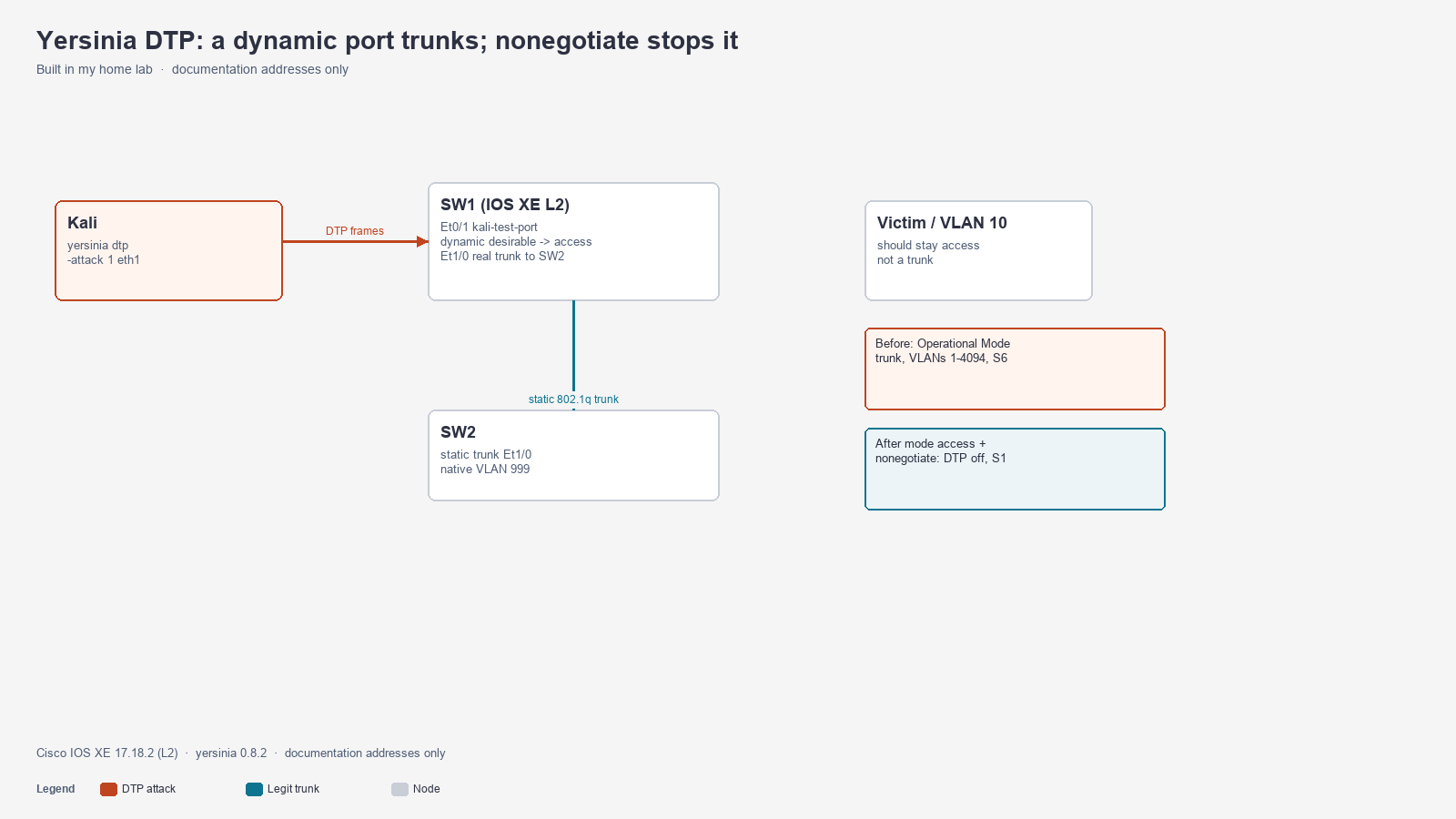
What DTP is doing
Dynamic Trunking Protocol lets two Cisco switches agree to trunk automatically. The administrative mode you set decides how a port behaves when a DTP partner appears.
| Administrative mode | Sends DTP? | Becomes a trunk if the neighbor is... |
|---|---|---|
dynamic auto | Responds only | trunk or desirable |
dynamic desirable | Actively asks | trunk, desirable, or auto |
trunk | Yes (unless nonegotiate) | always trunk |
access | No | never (stays access) |
nonegotiate | No | DTP off; mode is forced |
The risk is the two dynamic modes on a host-facing port. dynamic auto waits to be asked; dynamic desirable asks first. Yersinia supplies the DTP frame either one needs, so both end up as a trunk. I confirmed both in this lab: dynamic auto and dynamic desirable each went to Operational Mode: trunk under the same attack. The default on many older templates was dynamic auto, which is why unconfigured ports are the classic problem.
Lab setup
- SW1 — Cisco IOS XE 17.18.2 Layer 2 switch
- Kali — Kali Rolling, yersinia 0.8.2, on
eth1(no IP; DTP is Layer 2) - SW2 — a second switch on
Et1/0, a real static trunk, to show the fix does not break legitimate trunks - Victim — a host in VLAN 10
SW1 Et0/1 faces Kali, Et0/2 faces the victim, Et0/3 faces the gateway, Et1/0 is the inter-switch link to SW2. Addresses use documentation ranges only. Built in my home lab and torn down afterward.
Step 1: Install Yersinia
sudo apt install yersinia
yersinia dtp -attack ?
Attack 1 is NONDOS attack enabling trunking, the one used here. It is the single frame needed to see whether a port will negotiate a trunk. Everything else below is Cisco.
Step 2: Make the port vulnerable and baseline it
Set the test port to dynamic desirable, then record the starting state before any DTP from Kali:
interface Ethernet0/1
 switchport mode dynamic desirable
SW1# show interfaces Ethernet0/1 switchport | include Administrative Mode|Operational Mode|Negotiation
SW1# show interfaces trunk
SW1# show dtp interface Ethernet0/1 | include TOS|FSM|packets received|Enabled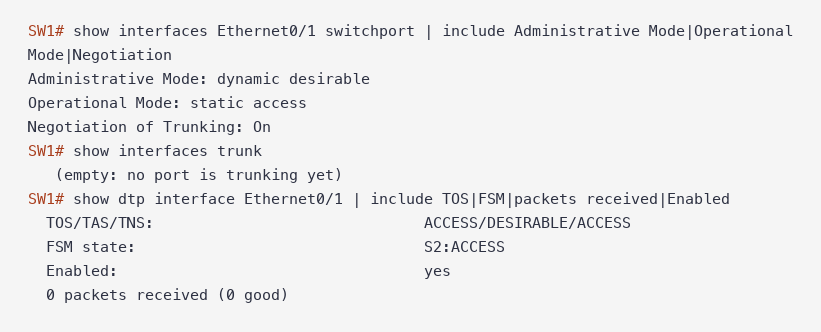
Read this carefully. Administrative Mode: dynamic desirable but Operational Mode: static access, because no partner has spoken DTP yet. Negotiation of Trunking: On is the warning sign. The trunk table is empty and DTP shows 0 packets received, FSM S2:ACCESS. A quick glance at "operational access" can fool you into thinking the port is safe. It is not; it is one DTP frame away from trunking.
Step 3: Run the trunking test
Yersinia's attack mode waits for a keypress, so pipe a long-lived stdin or it exits before the switch reacts:
tail -f /dev/null | yersinia dtp -attack 1 -interface eth1After about 20 seconds, poll SW1:
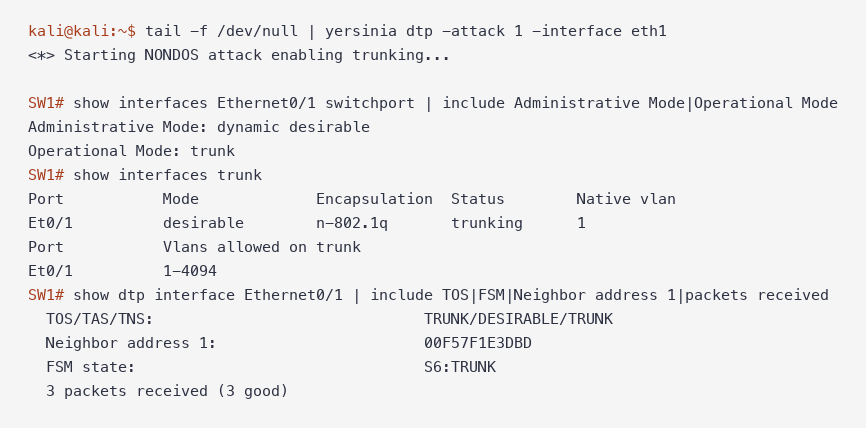
Reading the output
- Operational Mode: trunk is the finding. The administrative mode is still
dynamic desirable; the operational mode is what the wire is actually doing. - `show interfaces trunk` now lists
Et0/1, encapsulationn-802.1q, native VLAN 1, VLANs allowed 1-4094. A port that was meant to be a single-VLAN access port now carries every VLAN the switch knows. - DTP FSM state S6:TRUNK, neighbor MAC
00F57F1E3DBD(Yersinia's spoofed address), and3 packets received (3 good)prove the switch accepted Kali's DTP frames. Before the attack that counter was 0.
The frames on the wire
A capture on Kali shows the DTP exchange:
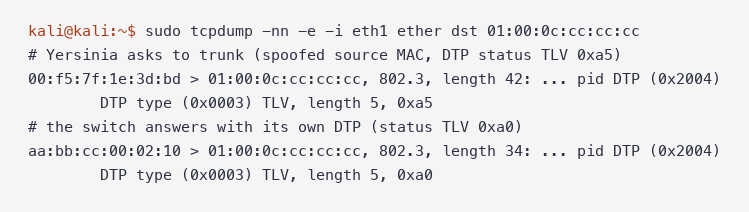
Yersinia sends DTPv1 frames from a spoofed source MAC to the Cisco DTP multicast 01:00:0c:cc:cc:cc, carrying a status TLV (0x03, value 0xa5) that asks to trunk. The switch answers with its own DTP frame (status value 0xa0). Those replies are the negotiation that flips the port.
Step 4: Harden the port
The fix is two lines on the access port, plus the usual host-port protections:
interface Ethernet0/1
 switchport mode access
 switchport access vlan 10
 switchport nonegotiate
 spanning-tree portfast
 spanning-tree bpduguard enable
SW1# show interfaces Ethernet0/1 switchport | include Administrative Mode|Operational Mode|Negotiation
SW1# show dtp interface Ethernet0/1 | include FSM|Enabled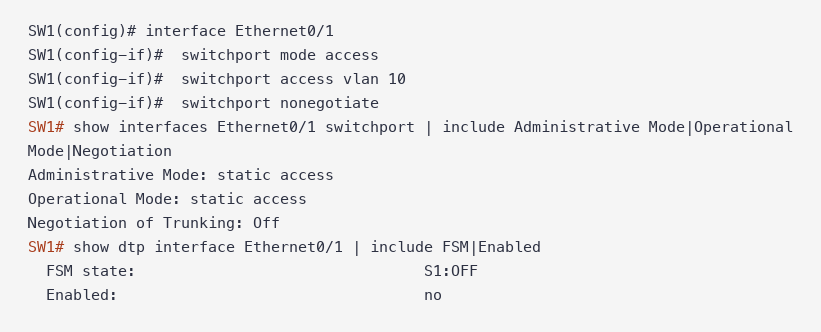
Negotiation of Trunking: Off and DTP Enabled: no, FSM state S1:OFF. switchport mode access alone sets the intent, but switchport nonegotiate is what actually silences DTP on the port. Use both.
Step 5: Prove the fix holds
Run the same Yersinia attack for another 25 seconds against the hardened port, with the legitimate trunk to SW2 live:
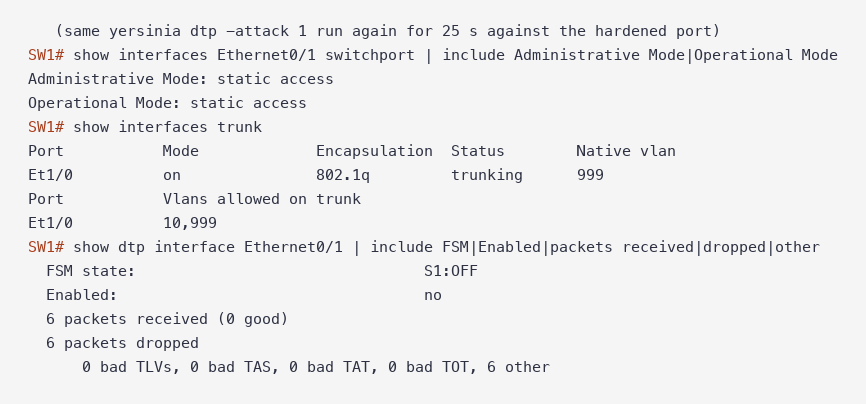
Yersinia still sends frames, but the switch counts 6 packets received (0 good), drops all 6 as other, stays in S1:OFF, and never forms a trunk. The only entry in show interfaces trunk is Et1/0, the legitimate static trunk to SW2 on native VLAN 999. The hardening stopped the attack without touching the real trunk, which is the result you want: the control blocks the negotiation but leaves authorized trunking alone.
The hardening template
Apply this to every host-facing access port, and keep real trunks static:
! host ports
interface range Ethernet0/1 - 2
 switchport mode access
 switchport access vlan 10
 switchport nonegotiate
 spanning-tree portfast
 spanning-tree bpduguard enable
!
! unused ports: shut, in a parking VLAN
interface range Ethernet1/1 - 3
 switchport mode access
 switchport access vlan 999
 switchport nonegotiate
 shutdown
!
! real trunk: static, DTP off, native VLAN moved off 1
interface Ethernet1/0
 switchport trunk encapsulation dot1q
 switchport mode trunk
 switchport trunk native vlan 999
 switchport trunk allowed vlan 10,999
 switchport nonegotiate
Three habits matter here: switchport nonegotiate everywhere so DTP never runs, unused ports shut in a dead parking VLAN, and the native VLAN moved off VLAN 1 on trunks. During the attack the formed trunk used native VLAN 1 even though the access VLAN was 10, and that mismatch is the opening for double-tagging VLAN hopping.
At scale, do not configure this port by port. Define the access-port behavior once (an interface template or your switch build macro), apply it to every edge range, and keep switchport nonegotiate in the base template so a newly patched port is never a dynamic port. A good show interfaces status or show interfaces trunk audit after any change catches the one port someone set by hand.
Verification methods compared
| Method | What it tells you | Speed |
|---|---|---|
show interfaces switchport | Administrative vs operational mode, negotiation state | Instant, per port |
show interfaces trunk | Which ports are actually trunking right now | Instant, switch-wide |
show dtp interface | DTP FSM state, neighbor, packet counters | Instant, deepest detail |
| DTP capture in Wireshark/tcpdump | The frames themselves, for proof | Needs a capture |
| Yersinia active test | Confirms behavior end to end | ~20 s per port |
For a routine audit, show interfaces trunk across the switch plus Negotiation of Trunking is enough. The active Yersinia test is for proving a specific port really resists.
What breaks
The hardening is safe on access ports, but a few changes bite if you apply them without reading the port first.
- `nonegotiate` on a trunk that still relies on DTP. If an inter-switch link was coming up only because both sides negotiated, forcing
nonegotiatewithout setting a staticswitchport mode trunkon both ends drops the trunk. Make the trunk static first, then turn DTP off. - Encapsulation ordering on this image.
switchport mode trunkis rejected untilswitchport trunk encapsulation dot1qis set, andswitchport nonegotiateis rejected while the mode is still dynamic. Set encapsulation, then mode, then nonegotiate. - A formed trunk carries every VLAN. While the attacked port was trunking it allowed VLANs 1-4094, so any VLAN on the switch was briefly reachable from that port. That is why the test must stay in an isolated lab.
- Native VLAN 1 on the formed trunk. The attacker-formed trunk took native VLAN 1 even though the access VLAN was 10. Moving native VLANs off 1 on real trunks closes the double-tagging path.
DTP hardening cheat sheet
| Goal | Command |
|---|---|
| Force access, no negotiation | switchport mode access + switchport nonegotiate |
| Protect the edge | spanning-tree portfast + spanning-tree bpduguard enable |
| Static trunk, DTP off | switchport trunk encapsulation dot1q then switchport mode trunk then switchport nonegotiate |
| Move native off VLAN 1 | switchport trunk native vlan 999 |
| Park unused ports | switchport access vlan 999 + shutdown |
| Audit | show interfaces trunk, show interfaces switchport, show dtp interface |
Gotchas
Yersinia exits immediately. Attack mode waits for a keypress; if stdin closes it stops before the switch reacts. Pipe tail -f /dev/null or run it from a real terminal.
"Operational Mode: static access" is not "safe". On a dynamic port that just means no partner has spoken DTP yet. Check Negotiation of Trunking; if it is On, the port is exposed.
Static trunks need encapsulation first. On this image, switchport mode trunk is rejected until you set switchport trunk encapsulation dot1q, and switchport nonegotiate is rejected while the mode is still dynamic. Set encapsulation, then mode, then nonegotiate.
Native VLAN 1 on a formed trunk. The attacker-formed trunk took native VLAN 1 even though the access VLAN was 10. Move native VLANs off 1 on real trunks to close the double-tagging path.
FAQ
Does `dynamic auto` also trunk with Yersinia?
Yes, confirmed in this lab. dynamic auto waits for the other side to ask, and Yersinia's enabling-trunking attack is that ask, so the port went to Operational Mode: trunk just like dynamic desirable. dynamic desirable is more aggressive because the switch asks first, but both end in a trunk once DTP succeeds.
Is `switchport mode access` enough without `nonegotiate`?
Not on its own. Mode access sets intent, but DTP can still run unless you add nonegotiate. In this lab, mode access plus nonegotiate left DTP Enabled: no and FSM S1:OFF, and the re-run attack counted 6 packets received (0 good). Use both on host ports.
Will `nonegotiate` break a real trunk between switches?
Only if the trunk still relies on DTP to come up. Configure inter-switch links as static switchport mode trunk with switchport nonegotiate on both ends, as on Et1/0 above, and DTP is simply not needed. The static trunk to SW2 kept working throughout the hardened re-test.
What is the native VLAN mismatch about?
A trunk has one native (untagged) VLAN. If an access port trunks with native VLAN 1 while hosts live in VLAN 10, an attacker can double-tag frames to hop VLANs. Moving native VLANs off 1 and never trunking host ports closes that.
Can Yersinia also attack STP?
Yes, through separate STP attacks such as claiming root. That is a different test; pair it with BPDU Guard and Root Guard rather than mixing it into this DTP proof.
Is Yersinia still maintained?
Upstream releases are infrequent. Kali still ships 0.8.2 and it worked for this DTP test. Treat it as a lab audit tool, not a production dependency.
Key takeaways
yersinia dtp -attack 1against adynamic desirableordynamic autoport formed a full trunk in about 20 seconds;show interfaces trunkand DTP FSMS6:TRUNKwere the proof.switchport mode accessplusswitchport nonegotiatestopped the same attack: DTP went toEnabled: no, FSMS1:OFF, and the re-run counted 6 packets received, 0 good.- Read
Negotiation of Trunking, not just operational mode; a dynamic port can read "static access" and still be one frame from trunking. - Harden every host port to static access with DTP off, park and shut unused ports, and keep real trunks static with the native VLAN off 1.
One line of scope: this validates DTP hardening on access ports; VTP, STP root attacks, and 802.1X on the edge are separate controls with their own tests.
More in this series: thc-ipv6 on Kali to test IPv6 RA Guard on the same switch, arpwatch to catch other Layer 2 spoofing on the wire, and How to Use Wireshark to read the DTP captures.