
One of the most common iBGP issues is a route that appears in the BGP table but never makes it into the IP routing table. The usual culprit is an unreachable BGP next-hop, and the way to prove it is recursive next-hop resolution: on the receiving router, run show ip route against the next-hop address and see whether it resolves. The behavior behind it is RFC 4271: iBGP, unlike eBGP, does not rewrite the next-hop attribute by default when advertising routes to peers within the same AS. The next-hop-self command fixes this - but understanding why it's needed and when to apply it is more important than just blindly adding it everywhere.
New to BGP? Start with the full BGP guide, then come back here for the deep dive.
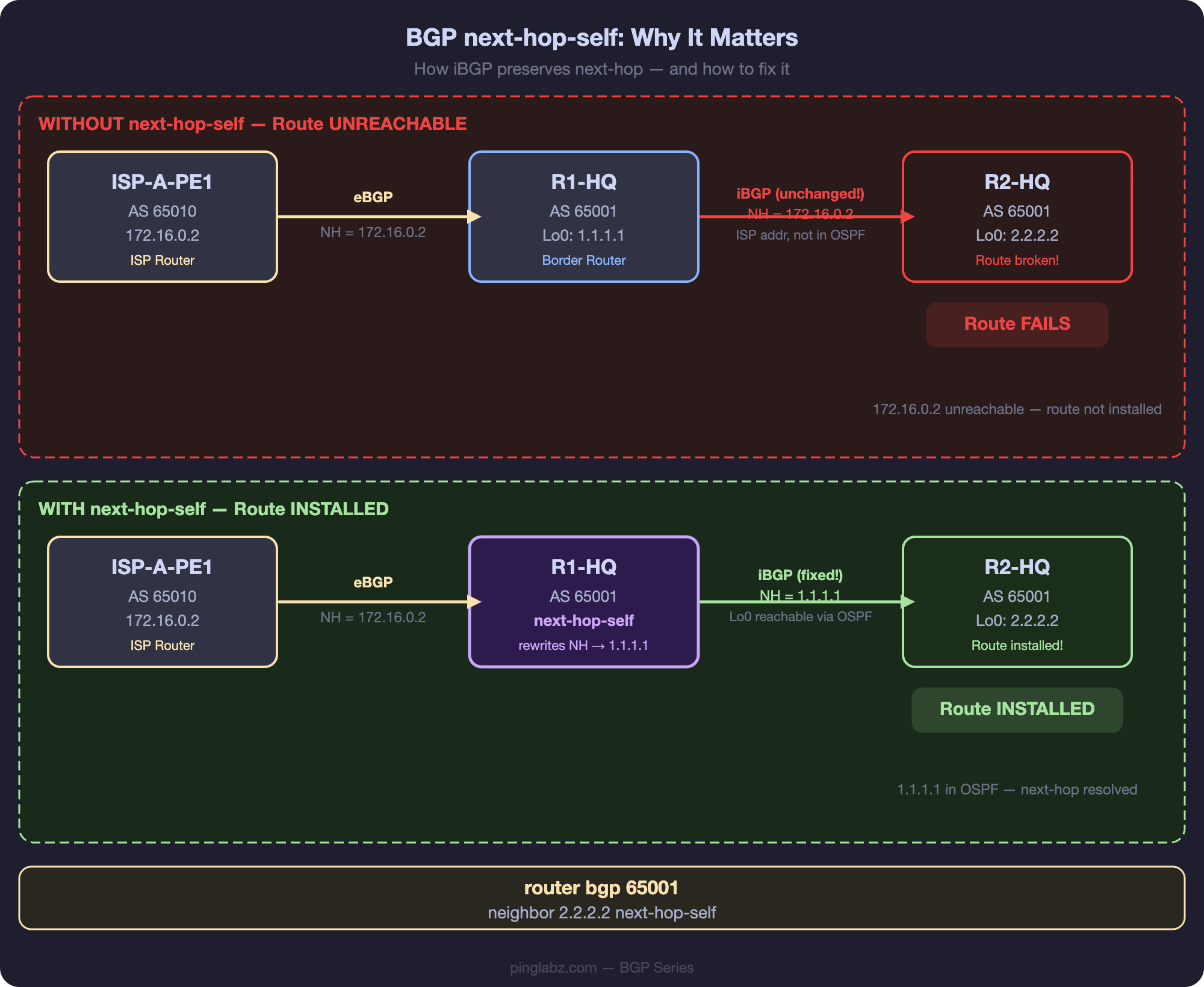
The Problem
In our PingLabz BGP Lab, R1-HQ (AS 65001) learns the prefix 100.64.0.0/18 from ISP-A-PE1 via eBGP. The next-hop is set to 172.16.0.2 (ISP-A's interface on the transit link).
R1-HQ# show ip bgp 100.64.0.0/18
BGP routing table entry for 100.64.0.0/18, version 8
Paths: (1 available, best #1, table default)
  65010
    172.16.0.2 from 172.16.0.2 (203.0.113.1)
      Origin IGP, metric 0, localpref 100, valid, external, best
When R1-HQ advertises this route to R2-HQ over iBGP, the next-hop stays as 172.16.0.2. R2-HQ receives the route:
R2-HQ# show ip bgp 100.64.0.0/18
BGP routing table entry for 100.64.0.0/18, version 0
Paths: (1 available, no best path)
  65010
    172.16.0.2 (inaccessible) from 1.1.1.1 (1.1.1.1)
      Origin IGP, metric 0, localpref 100, valid, internal
      rx pathid: 0, tx pathid: 0
Notice: (inaccessible) and no best path. The route exists in R2-HQ's BGP table but is not valid for path selection because 172.16.0.2 isn't in R2-HQ's routing table. R2-HQ has no direct connection to the ISP-A transit link and no route to that /30 subnet.
The route will NOT appear in show ip route. Traffic to 100.64.0.0/18 will be dropped or follow a less-specific default route.
The Fix
On R1-HQ, add next-hop-self for the iBGP peer:
R1-HQ(config)# router bgp 65001
R1-HQ(config-router)# neighbor 2.2.2.2 next-hop-self
Now when R1-HQ advertises the route to R2-HQ, it changes the next-hop to its own loopback (1.1.1.1):
R2-HQ# show ip bgp 100.64.0.0/18
BGP routing table entry for 100.64.0.0/18, version 12
Paths: (1 available, best #1, table default)
  65010
    1.1.1.1 from 1.1.1.1 (1.1.1.1)
      Origin IGP, metric 0, localpref 100, valid, internal, best
      rx pathid: 0, tx pathid: 0x0
Now the next-hop is 1.1.1.1, which R2-HQ can reach via OSPF. The route is valid, best, and installed in the routing table.
Why Doesn't iBGP Change the Next-Hop Automatically?
It seems like a design flaw, but there's a reason. In networks where all BGP speakers are on a shared segment (like an IXP or a large LAN), the internal routers can reach the external next-hop directly. Preserving the original next-hop avoids an extra hop through the border router. The traffic goes directly from the internal router to the external next-hop across the shared segment.
In practice, this topology is uncommon in enterprise networks. Almost every enterprise deployment needs next-hop-self on border routers for their iBGP peers.
next-hop-self vs next-hop-self all
Standard next-hop-self only changes the next-hop for eBGP-learned routes when advertising to iBGP peers. It does NOT change the next-hop for routes learned from other iBGP peers.
The all keyword changes the next-hop for ALL routes, including iBGP-learned ones:
R1-HQ(config-router)# neighbor 2.2.2.2 next-hop-self allThis is typically only needed in route reflector environments where reflected routes might have next-hops from other RR clients, and it carries a documented caveat: an RR that rewrites the next-hop on reflected routes pulls the data path through itself (RFC 4456 expects reflectors to pass attributes through unmodified). In most cases, standard next-hop-self (without all) is sufficient.
Alternative: Redistribute the Transit Link into IGP
Instead of next-hop-self, you could include the transit link subnet (172.16.0.0/30) in OSPF so that R2-HQ has a route to 172.16.0.2. This works but leaks ISP-facing subnets into your IGP, which is generally undesirable - especially if you have many transit links. next-hop-self is the cleaner solution.
Verification Commands
! Confirm next-hop-self is configured
R1-HQ# show ip bgp neighbors 2.2.2.2 | include next hop
  Route map for outgoing advertisements is *not set*
  NEXT_HOP is always this router for eBGP paths

! Verify R2-HQ sees the corrected next-hop
R2-HQ# show ip bgp 100.64.0.0/18
  ...
    1.1.1.1 from 1.1.1.1 (1.1.1.1)
      Origin IGP, metric 0, localpref 100, valid, internal, best

! Confirm route is in the IP routing table
R2-HQ# show ip route 100.64.0.0
Routing entry for 100.64.0.0/18
  Known via "bgp 65001", distance 200, metric 0
  Tag 65010, type internal
  Last update from 1.1.1.1 02:15:33 ago
  Routing Descriptor Blocks:
  * 1.1.1.1, from 1.1.1.1, 02:15:33 ago
      Route metric is 0, traffic share count is 1
      AS Hops 1
Troubleshooting
next-hop-self not configured on the border routerneighbor [peer] next-hop-self on the border router for all iBGP peers.clear ip bgp [peer] soft out to re-advertise with the new next-hop.show ip route [prefix] to see which protocol is winning. This is expected behavior.Key Takeaways
- iBGP preserves the original eBGP next-hop by default. This causes routes to be marked "inaccessible" on internal routers that can't reach the external next-hop.
next-hop-selfon border routers is the standard fix - it changes the next-hop to the border router's own address (usually a loopback) when advertising to iBGP peers.- The original behavior exists for shared-segment scenarios (IXPs), but enterprise networks almost always need next-hop-self.
- After adding
next-hop-selfto an existing session, do a soft outbound reset to trigger re-advertisement with the corrected next-hop. - Always verify with
show ip bgp [prefix]on the receiving router - look for "(inaccessible)" or "no best path" as indicators of next-hop issues.