Cisco Read-Only User: Privilege Levels vs Parser Views
Built in my home lab on IOS XE 17.18: a privilege 5 NOC user got an empty config, then every secret. Parser views worked, once exec and console authorization were on.
GUIDES MEET PRACTICE
Clear networking guides and 68 CCNA browser labs. Learn the concepts, practice IOS-style commands, and check your work as you go.
One lab free. No account, installation, or hardware needed.
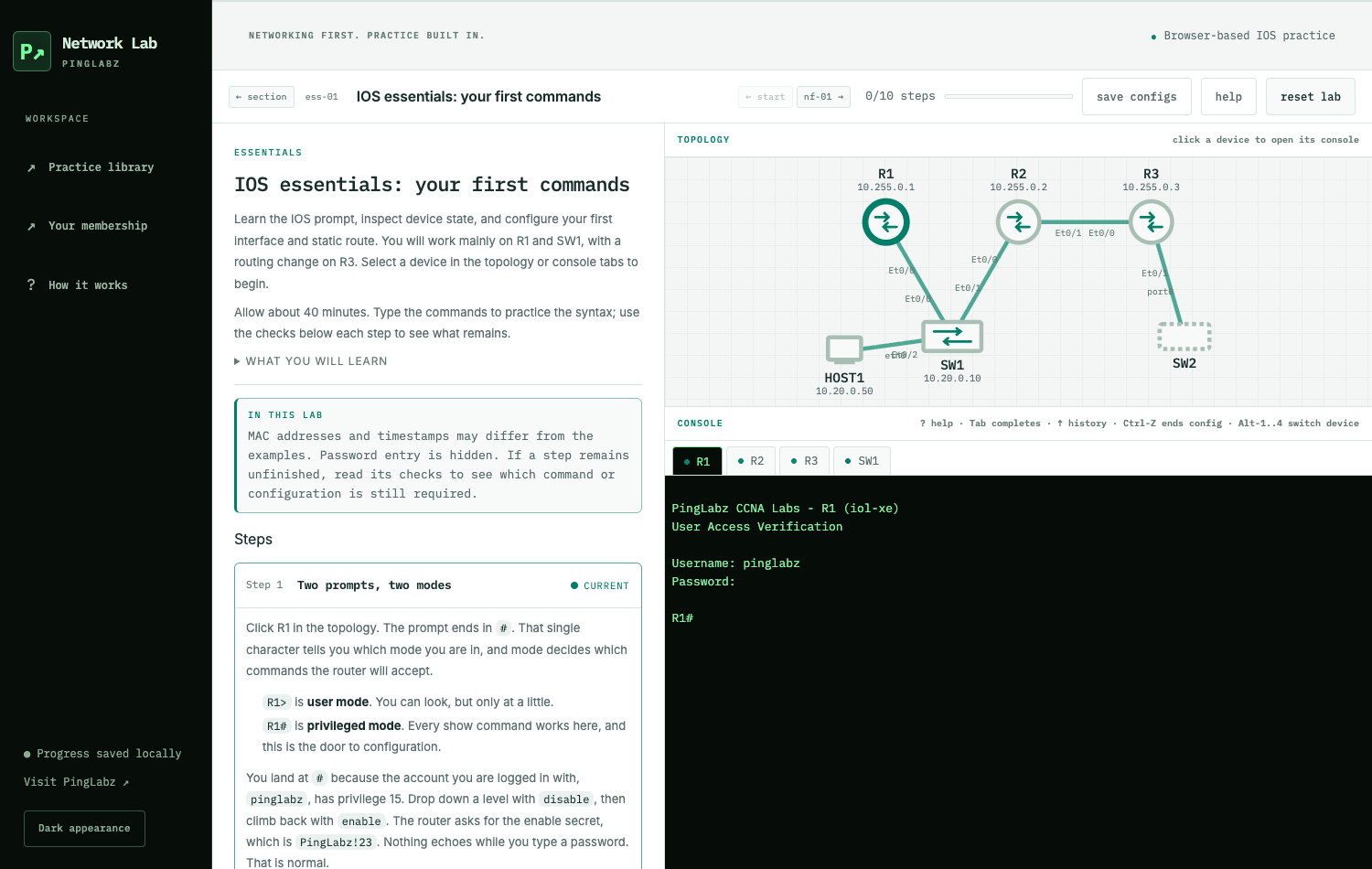
A browser simulation of selected IOS behavior. It does not run an IOS image.
EXPLORE THE LIBRARY
Models, addresses, and the basics that connect everything.
↗ 02Switching & VLANsBuild and troubleshoot Layer 2 networks.
↗ 03RoutingUnderstand forwarding decisions and paths.
↗ 04Security & accessExplore controls, authentication, and firewalls.
↗ 05WirelessFrom WLAN fundamentals to controller operations.
↗ 06Linux & toolsDiagnose and verify from the command line.
↗FREE FIELD REFERENCES
A free PingLabz account unlocks the Linux, ASA, BGP, and OSPF PDFs. Choose the guide you need and keep it close while you practice.
GO FURTHER WITH PRO
Pro unlocks 60 build labs, six troubleshooting labs, and the campus Mega Lab. Follow guided exercises, try IOS-style commands, and check your configuration as you go.
SELECTED READING
Keep learning
Built in my home lab on IOS XE 17.18: a privilege 5 NOC user got an empty config, then every secret. Parser views worked, once exec and console authorization were on.
Built in my home lab on IOS XE 17.18: stale SSH sessions filled every VTY line and locked the admin out. Keepalives, exec-timeout and a reserved line fixed it.
Built in my home lab on IOS XE 17.18: decoded every Type 7 password in seconds, migrated to Type 8, and broke Type 6 by removing the master key.
Built in my home lab on IOS XE 17.18: login block-for quiet mode locked out the admin too. A quiet-mode access-class let the NOC in while the attacker stayed refused.
Built in my home lab on IOS XE 17.18: a sniffed SNMPv2c RW community renamed the router and shut OSPF. SNMPv3 authPriv with an ACL stopped it.
Built in my home lab on IOS XE 17.18: a strict CoPP policy policed OSPF together with an ICMP flood, the neighbor went down, and one routing class fixed it.
Built in my home lab on IOS XE 17.18: a wrong VTY access-class locked out SSH, then a management VRF did it again with no ACL hits. Both recovered from the console.
Built in my home lab: one script pulls show output from an IOL console, captures a ping in the client's network namespace, redacts management IPs, then cleans up.
Built in my home lab: FMCv held 32 GiB of a 63 GiB host. IOL, IOSv-L2, ASAv and one-FTDv labs ran beside it; a dual-FTDv boot left FMC unhealthy for 183 s.
Built in my home lab: twelve Containerlab tests decide IOL, IOL-L2 or IOSv-L2. IOSv-L2 won dynamic DHCP snooping and 802.1X; IOL-L2 won IPSG, RA Guard and SPAN.
Built in my home lab: one ICMP packet, an IOS XE permit and an ASA deny. A legacy ASA timestamp with no timezone flipped the order; UTC and rfc5424 fixed it.
Built in my home lab: a 51-line Zeek script flags rogue DHCP and gateway ARP spoofing, but only after SPAN sends it the unicast attack frames.