
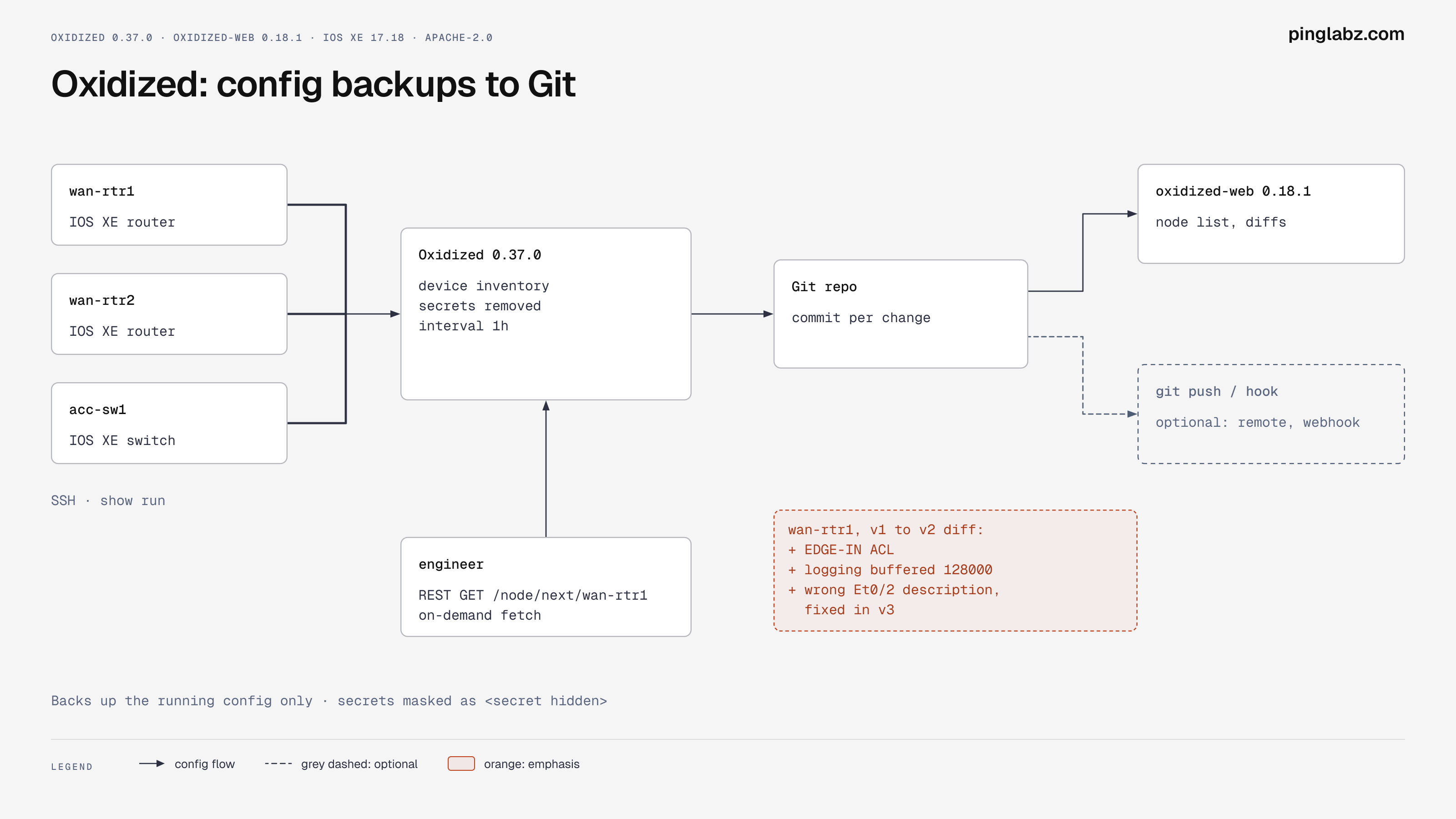
Oxidized logs into your routers and switches on a schedule, pulls the running config, and commits it to Git, so every change becomes a timestamped diff. On three Cisco IOS XE 17.18 devices it took one YAML file, one device list, and one container, and the first diff caught a wrong interface description.
Every outage review I've sat through has the same awkward moment: someone asks "what changed?" and nobody can answer with certainty. The router config from last Tuesday is gone, the change ticket says one thing, and the box says another. Oxidized fixes that cheaply.
Part of the Open Source Network Config Tools: Oxidized, Batfish, NetBox, and Ansible. Scope: running-config backups with a local backup user; TACACS+ command authorization is recommended but not built here.
Built in my home lab: two Cisco IOS XE WAN routers (wan-rtr1, wan-rtr2), one IOS XE access switch (acc-sw1), and a Linux host running Docker.
Versions and license
- Oxidized 0.37.0 (released May 2026), container image
oxidized/oxidized:0.37.0. Apache-2.0 license. - oxidized-web 0.18.1, bundled in the same image.
- Cisco IOS XE 17.18 on all three devices.
Oxidized is fully open source, with no paid tier needed for anything in this post.
The device side: a dedicated backup user
Don't reuse your admin account. Give Oxidized its own local user so its logins stand out in AAA logs and you can pull its access without touching anyone else. I used privilege 15 because show running-config needs it on IOS XE unless you build a custom privilege level. In production, put it behind TACACS+ with a command-authorization set that only allows show commands.
username oxidized privilege 15 secret <OXIDIZED_PASSWORD>In the lab I added this to the running config only and didn't save it. Do save it in production, or the backups stop after the next reload.
Oxidized config
Oxidized reads a YAML config and a device list. The simplest source is a CSV-style file, one device per line: name, IP, model.
# router.db
wan-rtr1:10.66.20.11:ios
wan-rtr2:10.66.20.12:ios
acc-sw1:10.66.20.21:ios
---
username: oxidized
password: <OXIDIZED_PASSWORD>
model: ios
interval: 3600
timeout: 30
retries: 1
rest: 0.0.0.0:8888
vars:
remove_secret: true
input:
default: ssh
ssh:
secure: false
output:
default: git
git:
user: Oxidized
email: oxidized@example.net
repo: /home/oxidized/.config/oxidized/configs.git
source:
default: csv
csv:
file: /home/oxidized/.config/oxidized/router.db
delimiter: !ruby/regexp /:/
map:
name: 0
ip: 1
model: 2A few of those lines matter more than they look:
remove_secret: truemasks passwords, secrets and SNMP communities in the stored config. Without it, your Git repo is a password file. More on what it does and doesn't catch below.interval: 3600polls every hour. You can trigger a node on demand through the REST API, which is how I got the diffs below without waiting.secure: falseskips SSH host-key checking. That's fine for a lab and a bad idea in production; turn it on and pre-load the known hosts.- The config file holds the device password, so lock it down: mine is in a directory with mode 700, and the password file is mode 600.
Then run the container:
docker run -d --name pl-oxidized --restart unless-stopped \
  -v ~/labs/oxidized/cfg:/home/oxidized/.config/oxidized \
  -p 8888:8888 \
  oxidized/oxidized:0.37.0
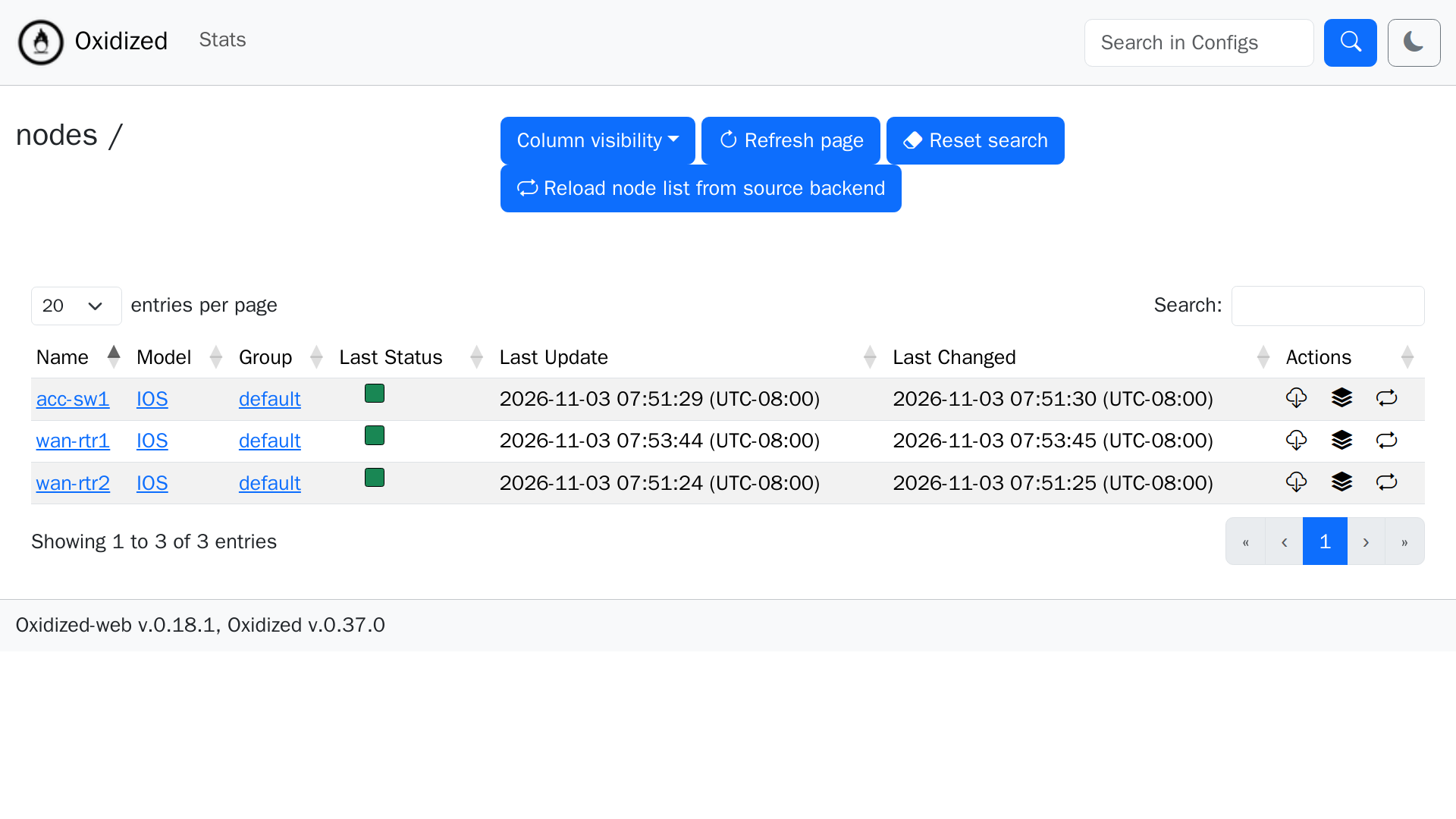
Within about a minute, all three devices showed a green status in the web UI.
Making a real change
I gave the backup something to catch. Under a made-up change ticket, CHG-1042, I made three changes on wan-rtr1:
ip access-list extended EDGE-IN
 10 permit tcp 10.0.0.0 0.255.255.255 any eq 22
 20 permit icmp any any echo-reply
 30 deny tcp any any eq telnet log
 40 permit ip any any
!
interface Ethernet0/2
 description WAN-B to wan-rtr2 | change CHG-1042
!
logging buffered 128000
Then I asked Oxidized to fetch wan-rtr1 now, instead of waiting for the hour:
curl -s http://<oxidized-host>:8888/node/next/wan-rtr1A few seconds later there was a new commit. The diff view in oxidized-web shows exactly what moved:
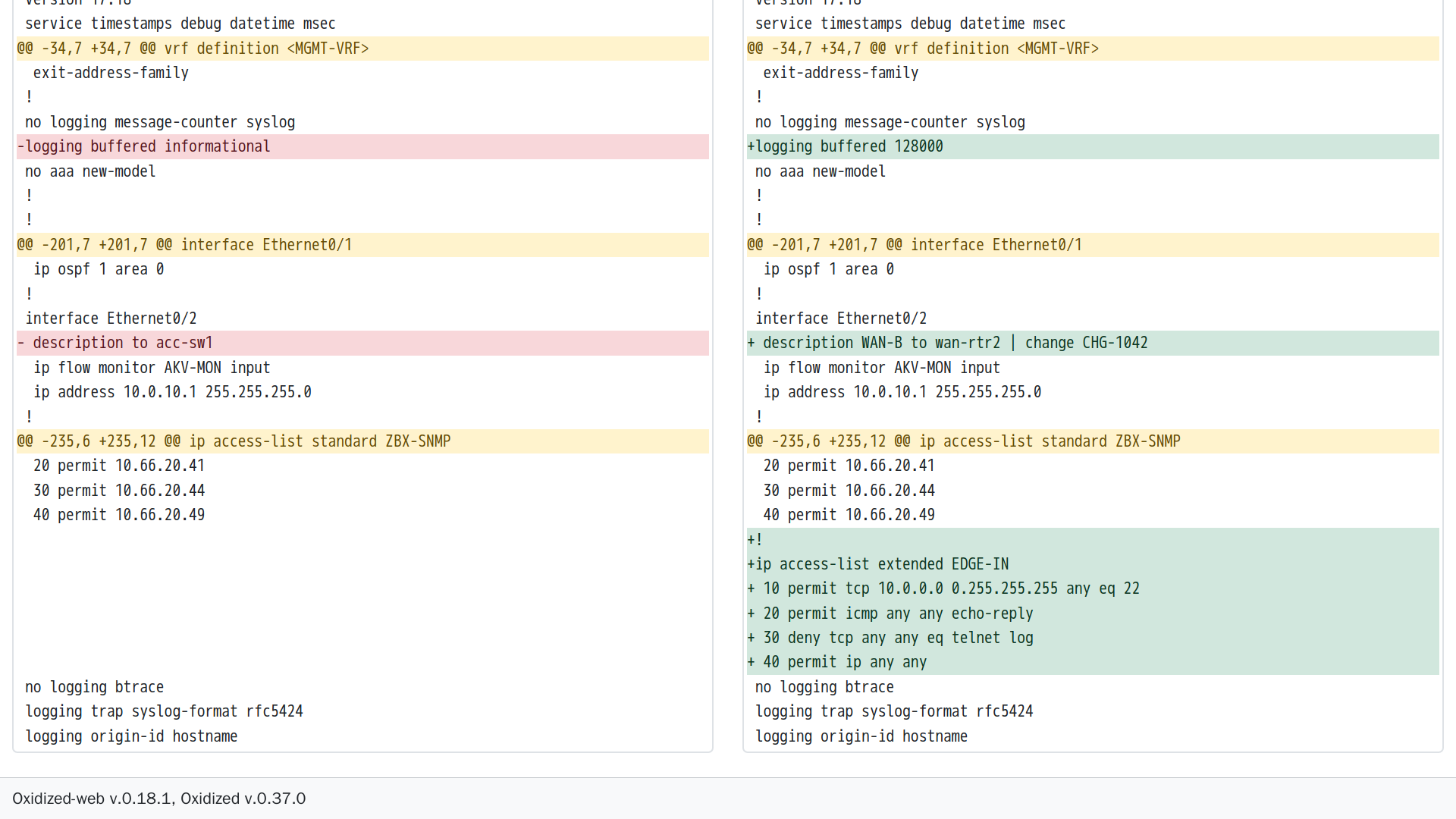
That diff caught a real mistake. Et0/2 on wan-rtr1 faces acc-sw1, not wan-rtr2. I'd written the wrong description. That is exactly the kind of small, wrong change that misleads someone at 2 a.m. I fixed it, triggered another fetch, and Git recorded the fix as its own version:
$ git --git-dir=configs.git log --format='%h %an %ad %s' --date=iso -- wan-rtr1
a40b796 Oxidized 2026-11-03 15:53:45 +0000 update /wan-rtr1
082fdcf Oxidized 2026-11-03 15:52:58 +0000 update /wan-rtr1
4fc7875 Oxidized 2026-11-03 15:51:20 +0000 update /wan-rtr1

$ git --git-dir=configs.git show a40b796 -- wan-rtr1
@@ -12,7 +12,7 @@
-! Last configuration change at 15:52:51 UTC Tue Nov 3 2026 by admin
+! Last configuration change at 15:53:37 UTC Tue Nov 3 2026 by admin
@@ -201,7 +201,7 @@ interface Ethernet0/1
 interface Ethernet0/2
- description WAN-B to wan-rtr2 | change CHG-1042
+ description to acc-sw1 | CHG-1042
  ip flow monitor AKV-MON input
  ip address 10.0.10.1 255.255.255.0
The repo is plain Git, so you can clone it, push it to your own Git server, or use any diff tool you like. Oxidized also has hooks to push to a remote or post to a webhook on each change.
What remove_secret hides, and what it doesn't
I grepped the stored config for the mask:
$ git --git-dir=configs.git show HEAD:wan-rtr1 | grep -n "secret hidden"
164:username admin privilege 15 secret 9 <secret hidden>
165:username oxidized privilege 15 secret 9 <secret hidden>
350:snmp-server host 10.66.20.5 vrf <MGMT-VRF> version 2c <secret hidden> udp-port 1162
Local user secrets and the SNMP host community got masked. But remove_secret is a list of regexes in the IOS model, not a guarantee. Anything it doesn't know about, like a pre-shared key in an unusual command or a free-text description with a password in it, goes into Git as written. Treat the repo as sensitive anyway: restrict access, and don't push it anywhere public.
The noise problem
Look at the first hunk of that last diff. IOS XE writes a ! Last configuration change at ... comment, and that line changes on every edit. That's fine here, because it only changes when the config does. The model already strips the uptime and NVRAM lines that would otherwise change on every poll, so in my lab acc-sw1 and wan-rtr2 were fetched again with no new commits. If you see a device committing every hour with no real change, look for a counter or timestamp in its output and add it to a model override.
Limits worth knowing
- Oxidized backs up the running config. It won't tell you that running and startup differ, which was literally true for wan-rtr1 here because that change was never saved there. Pair it with a check like Zabbix's config-change trigger from the syslog and traps post.
- A diff tells you what changed and when Oxidized saw it, not who changed it. The IOS comment line names the user, but for a real audit trail use AAA accounting or syslog into something like Loki.
- Hourly polling can miss a change that's made and reverted inside the hour. If that worries you, trigger a fetch from a syslog event (the
%SYS-5-CONFIG_Imessage) through the REST API.
FAQ
Does Oxidized back up the startup config? No. It stores the running config, so it will not tell you that running and startup differ.
What privilege level does the Oxidized user need on IOS XE? Privilege 15 for show running-config, unless you build a custom level. In production, use TACACS+ with a command set that allows only show commands.
Does remove_secret hide every password? No. It is a list of regexes in the IOS model. Local user secrets and the SNMP host community were masked here, but a key in an unusual command or a password in a description would be stored as written.
Can Oxidized back up a device as soon as it changes? Yes. Trigger a fetch through the REST API, for example from the %SYS-5-CONFIG_I syslog message, instead of waiting for the hourly poll.
What breaks
- Unsaved backup user. If the Oxidized account is only in the running config, backups stop after the next reload.
- Secrets
remove_secretdoes not know. They go into Git in clear text. Keep the repo private. - Change and revert inside one interval. Hourly polling never sees it.
- Hourly commits with no real change. A counter or timestamp in the output. Strip it with a model override.
secure: falsein production. It skips SSH host-key checks. Pre-load known hosts and turn it on.
Key takeaways
- Give Oxidized its own device account so its logins stand out and can be revoked alone.
- Turn on
remove_secret, then treat the Git repo as sensitive anyway. - Trigger fetches through the REST API for on-demand diffs; the first one here caught a wrong description.
- Pair it with syslog or AAA accounting, because a diff shows what changed, not who changed it.
Next: Batfish for Cisco IOS XE: Catch a Shadowed ACL Line and a Null Route Before Deployment · Series hub: Open Source Network Config Tools: Oxidized, Batfish, NetBox, and Ansible
Related: Zabbix Syslog and SNMP Traps from Cisco IOS XE: Trap Alert in 2.5 Seconds, Polling in 8.5 · Cisco IOS XE Syslog in Loki with Alloy: The RFC 5424 Fix and LogQL for Flaps and Changes